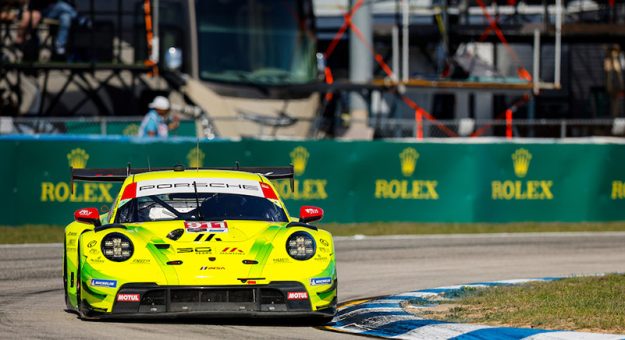
Across Either its GTD PRO or GTD Porsche, Team Going for Third Straight IMSA Michelin Endurance Cup Race Win
By David Phillips
DAYTONA BEACH, Fla. – With a 30-year heritage that includes six class wins in the 24 Hours of Le Mans, seven overall Nürburgring 24 Hours victories (including four straight from 2006 to 2009) a Bathurst 12 Hour win as well as team and driver championships in the FIA World Endurance Championship (WEC), Deutsche Tourenwagen Masters (DTM) and the Asian Le Mans Series, Manthey Racing ranks among the most successful sports car racing teams of our time. As well, Manthey’s renowned specialized tuning and performance operations have long worked in close collaboration with Porsche such that many of its products and upgrades are worthy of official Porsche OEM status.
But for all the notoriety its race team and performance products enjoy throughout Europe and Asia, Manthey has had little presence in North America apart from DNFs in the 2017 and ’18 Rolex 24 At Daytona. Until now.
Fielding two Porsche 911 GT3 R (992) cars in the Grand Touring Daytona Pro (GTD PRO) and GTD categories of the 2026 IMSA WeatherTech SportsCar Championship, Manthey is off to a rousing start in its IMSA Michelin Endurance Cup program.
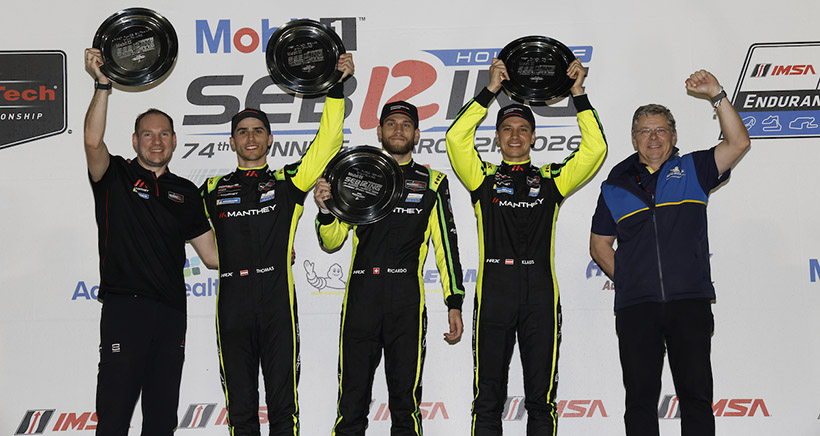
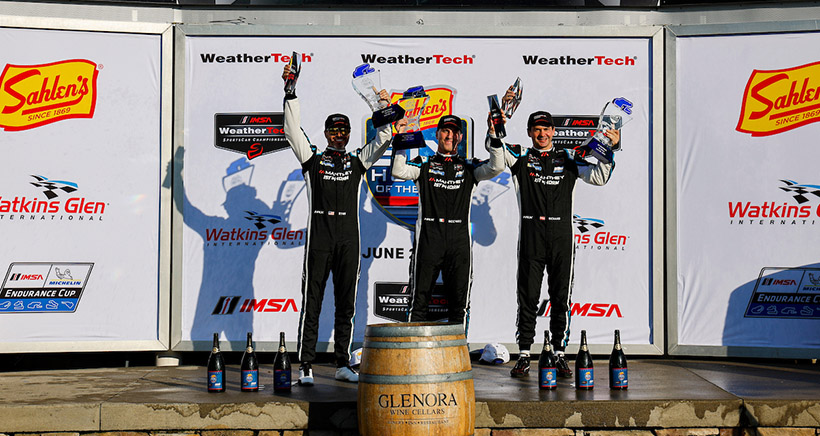
Both cars have wins, as its GTD PRO entry captured the Mobil 1 Twelve Hours of Sebring while its GTD Manthey 1st Phorm car won the Sahlen’s Six Hours of The Glen. The team has a chance for a unique “three-peat” in its first trip to Road America for the Motul SportsCar Endurance Grand Prix, where it could claim three straight IMSA endurance race wins across its two cars.
So the obvious questions are, “Why IMSA?” and “Why now?”
“It’s multiple aspects that make IMSA interesting,” says Patrick Arkenau, Manthey’s racing director. “First of all, it’s the North American market itself. Not only the sporting aspects but from a business perspective, the North American market is the biggest market for Porsche GT cars. So, it’s the biggest base of customers for our products in the road car business which we are selling through all the official Porsche centers in the U.S. We understood that the Manthey name is not as well known in the North American market as it is in Europe or even in Asia. Therefore, it’s been very interesting and tempting for us to promote our brand Manthey … what we stand for, that racing is in our DNA, in the North American market.
“Then for sure IMSA is very attractive on the sporting side. We’ve had success in Europe, we’ve been successful in the Asian Le Mans, we’ve been successful in Australia at Bathurst but North America has been a black dot in our map of mystery. We have had multiple attempts at Daytona in previous years where we couldn’t really succeed, so it’s something that we have to prove that we can be successful.
“Why in particular IMSA? First of all, the format is perfect. It’s a good mix of endurance racing which is racing for a long time, but when you come to the end it’s more like a DTM where the final hour is usually a sprint. So, it’s a perfect combination of all the series we are participating currently in, so we can use the knowledge from other series and combine it in IMSA. So, this is very unique and super interesting for us. Combining all those aspects makes IMSA the perfect choice and the only choice to prove what we want to prove in this market.”
No matter how many wins a team’s had at the Circuit de la Sarthe, the ‘Ring or Mount Panorama, there’s an element of – if not starting from scratch – starting behind the proverbial eight ball when tackling the WeatherTech Championship at Daytona International Speedway, Sebring International Raceway and Watkins Glen International. Not only are the tracks unfamiliar, but also there are differences – some subtle, some profound – in procedures, operations and the physical environment that require a period of adjustment.
“The biggest learning process we for sure had was in the IMSA-sanctioned test in November and at the Roar (Before The Rolex 24),” says Arkenau. “We had to connect the TVs properly, learn to deal with the very different situation (from Europe) where you have the base in the paddock and the pits are somewhere else, so you have let’s say two bases at the race track. All that stuff is new to us.
“We are very fortunate in that some of our engineering staff has experience on the IMSA side in various programs in GT and also GTP (Grand Touring Prototype). This helped a little but there has been a lot we learned; a lot of things we’ve had to adapt … for sure the restarts are very different. So there has been a lot we have learned and there is still a lot we have to learn, but I have been very happy with our progress.”
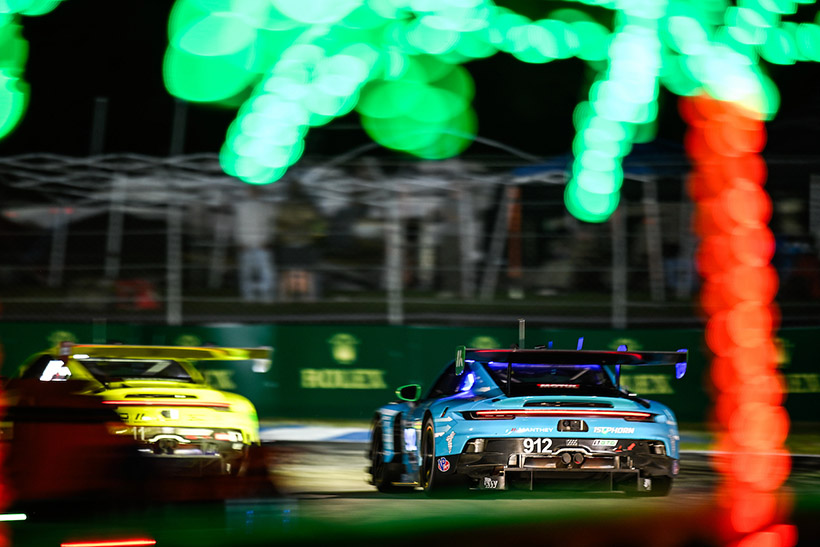
Indeed the evidence supports Arkenau’s view that Manthey is making quick work of its IMSA-learning curve. After an encouraging fifth place in GTD PRO at the Rolex 24, the No. 911 Manthey Porsche (aka “Grello” for its distinctive neon green and yellow livery) came home first at Sebring in the hands of Thomas Preining, Klaus Bachler and Ricardo Feller. And following indifferent results at Daytona and Sebring, the No. 912 Manthey 1st Phorm Porsche scored a GTD win at Watkins Glen with Riccardo Pera, Richard Lietz and Ryan Hardwick at the wheel.
The team’s lineup for Road America shifts slightly. Bachler and Preining are back in the No. 911 after a three-driver lineup of Bachler alongside Loek Hartog and Michael Christensen at Watkins Glen, as coincidentally Preining and Feller won the 24 Hours of Spa on the same weekend. Morris Schuring returns to the No. 912 car alongside Pera and Hardwick, as Lietz laughed that the Spa conflict is what got him the Watkins Glen drive in the first place.
Arkenau and his teammates are all the prouder of their performance given that they didn’t take any shortcuts. Manthey didn’t recruit a squad of veteran IMSA engineers, strategists, technicians, managers and mechanics. Rather the team relies on its core group, and while some may be familiar faces in the IMSA paddock, they are all adapting to IMSA’s idiosyncrasies as a unit.
“We are all learning together,” he says. “We didn’t hire a U.S. engineer or stuff like this; we do it all with our full-time Manthey group, mainly to make sure all the knowledge we gain stays here in the Manthey bubble. We always learn as a group. No single individual is learning: it’s a group who is learning and we all learn from each other day by day. And this is what we want to continue doing in IMSA. We might learn some things the hard way but at least we make sure if we learn, we learn as a company.”
Speaking of the hard way, rather than establish and staff a dedicated base of operations stateside, Manthey flies its race team from its headquarters in Germany for each IMSA race weekend.
Not ideal, perhaps, but in keeping with the “Manthey way.”
“For sure we are not doing it the easiest way, but it is the way we can do everything to ensure we do it the Manthey way; the same way we do everything in Europe with procedures, with tools …” Arkenau says.
“It’s very difficult and it’s definitely a challenge, but so far we have been very happy about how we could deal with that challenge. We are renting part of a workshop in Miami. We have all our own equipment, trucks and infrastructure (but) everything we do is with our European team. The guys have to fly in before the races, prepping the cars and staying long after the races doing the steps we can after the races (to prepare for the next race). This is for sure not ideal, but it has been the logical step for the first year, so we do not have to ship everything back and forth.”
Mitigating the scope of the challenge is the fact that Manthey is focused on the five-race Michelin Endurance Cup this season. While it remains to be seen if they will expand their program to the full WeatherTech Championship schedule next year, Manthey is committed to IMSA for the long haul.
“Absolutely (the full WeatherTech Championship season) is definitely the plan,” says Arkenau. “We have no idea if we will be able to make already that commitment already for 2027; maybe we have to delay it for the future, but it is definitely our plan to do the full season.
“We did not do the investment in getting the equipment and getting everything here for just a year. Our plan in IMSA is long-term not only in the racing but in our business sphere. We want to expand into the North American market. But this is something we will not be able to establish in a year or in a day. So it is definitely long-term plans, long-term commitment, we also want to expand our racing business in the U.S. but it has to grow naturally. Our company has always grown naturally. But for sure we have long-term plans and we want to spread out more than we are currently doing.”
That’s the Manthey way: doing things the hard way when necessary, learning as a group, growing naturally. And winning.